

Do You Need an Electrician for a Sauna? (And Will It Wreck Your Power Bill?)

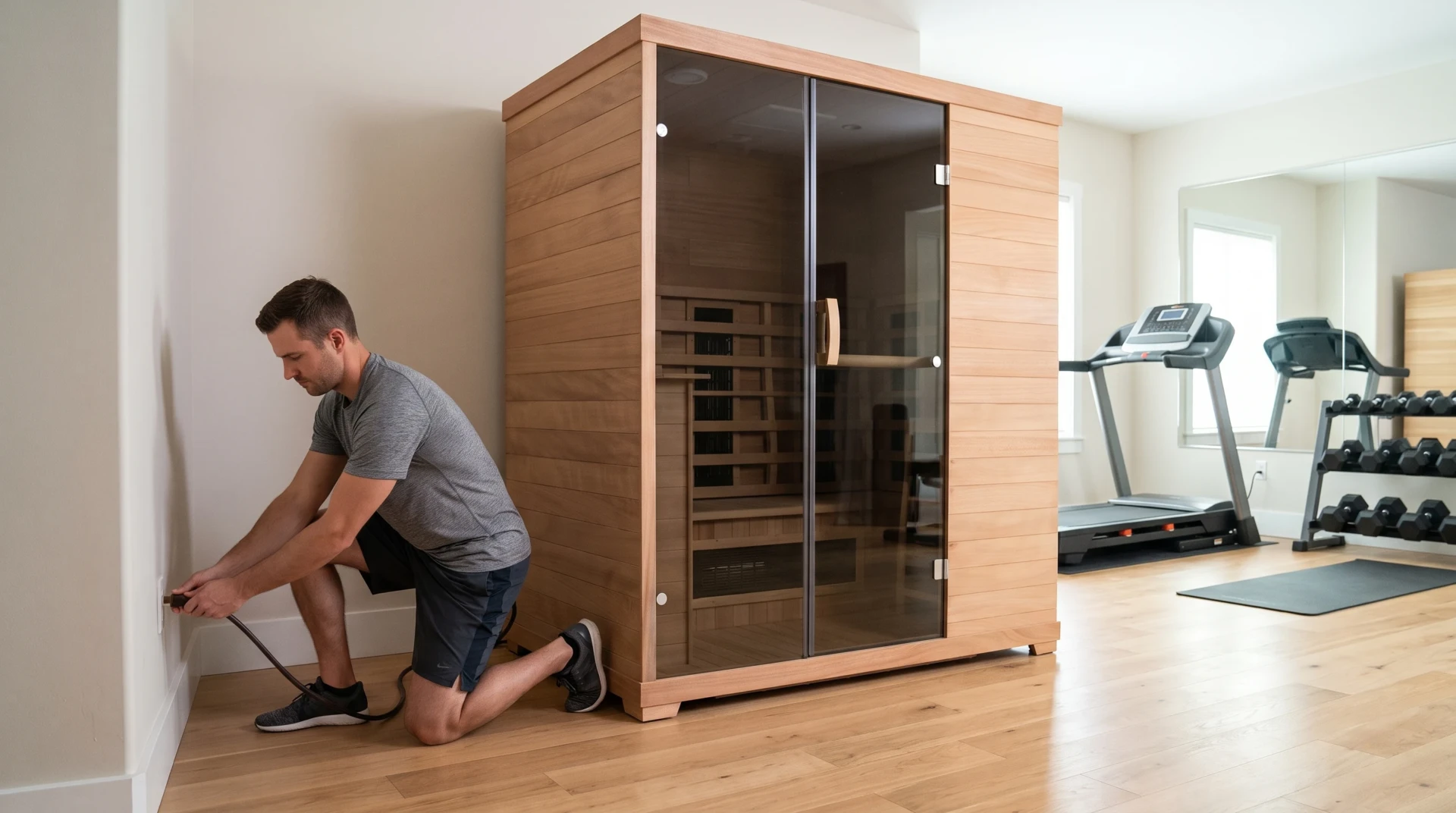
Almost every week, someone asks me two things. “Will I need an electrician? And what’s this going to do to my power bill?”
Fair questions. Plenty of saunas demand a new circuit, a city permit, and an electric bill that spikes every month.
Ours don’t. Still, don’t buy anything just because a sales guy said so. I’ve worked at High Tech Health for over a decade, I have a biochemistry background, and I trust hard math over sales pitches. Here is the actual math.
Why most traditional saunas need an electrician
Traditional units work by heating the air. Getting an entire box of air scorching hot takes a massive heater, usually 6 to 9 kilowatts for a home model.
You can’t plug a monster like that into a standard wall outlet. It demands 240 volts—the exact same heavy power your clothes dryer or oven pulls. That usually forces you to pay for:
- An electrician to run fresh wire from your main box
- A heavy-duty breaker and thick cable
- Local permits, depending on your town’s rules
- A whole new electrical panel if your house is old or your box is maxed out
Looking at our cost breakdown, just adding a new 240V circuit averages around $750 nationwide. That’s before touching your main panel.
Don’t assume infrared is automatically off the hook, either. Plenty of larger infrared models still require 240V. Always check the spec sheet for the exact size you want, not the tiny starter model on the front of the brochure.
Our saunas use a normal 120V outlet
Every single sauna we build runs on 120 volts. It’s the exact same power coming out of your kitchen or bedroom wall.
| Sauna | Size | Power use | What it plugs into |
| TR-1 / TRS-1 | 1 person | 950 watts | Standard 15-amp outlet |
| TR-2 / TRS-2 | 2 person | 1,620 watts | Standard 15-amp outlet, own circuit recommended |
| TR-3 / TRS-3 | 3 person | 1,920 watts | 20-amp outlet on its own circuit |
How do we use so little juice? Infrared skips heating the air and warms your body directly. Less wasted heat means way less power.
Having its “own circuit” simply means nothing else shares that specific breaker. The 2-person unit doesn’t strictly require a dedicated line, though we strongly suggest it. The math below shows why.
The math, minus the headache
Every circuit in your house has a hard ceiling. Multiply the breaker’s amps by 120 to find yours. A 15-amp circuit maxes out at 1,800 watts. A 20-amp circuit handles up to 2,400 watts.
Your sauna eats up a chunk of that limit, leaving the leftovers for whatever else is plugged into that same line. The TR-1 leaves roughly 850 watts free. The TR-2 leaves about 180. The TR-3 leaves around 480 watts on its 20-amp line.
Compare those leftovers to what everyday household gear pulls:
| Item | Typical watts |
| Hair dryer | 1,200 to 1,875 |
| Clothes iron | 1,000 to 1,800 |
| Space heater | 750 to 1,500 |
| Vacuum | 1,000 to 1,440 |
| Toaster | 800 to 1,400 |
| Coffee maker | 900 to 1,200 |
| Microwave | 750 to 1,100 |
| Dehumidifier | 785 |
| Refrigerator | 725 |
| Flat-screen TV | 120 |
| Ceiling fan | 65 to 175 |
| Laptop | 50 |
(Wattage numbers come from the Virginia Cooperative Extension.)
Why breakers trip, and why you want them to
A breaker doesn’t exist to save your sauna. It exists to save the wires hidden behind your drywall.
Copper wire can only carry so much juice before it starts cooking. A 15-amp circuit uses skinnier wire than a 20-amp circuit. Force too much power through skinny wire and it gets hot enough to melt its plastic jacket. That’s how house fires start.
Inside your breaker sits a tiny metal strip that heats up right alongside your wall wires. When things get too hot, that strip bends and snaps the power off. That’s why your sauna can run fine for ten minutes, then die the second someone flips on a hair dryer down the hall.
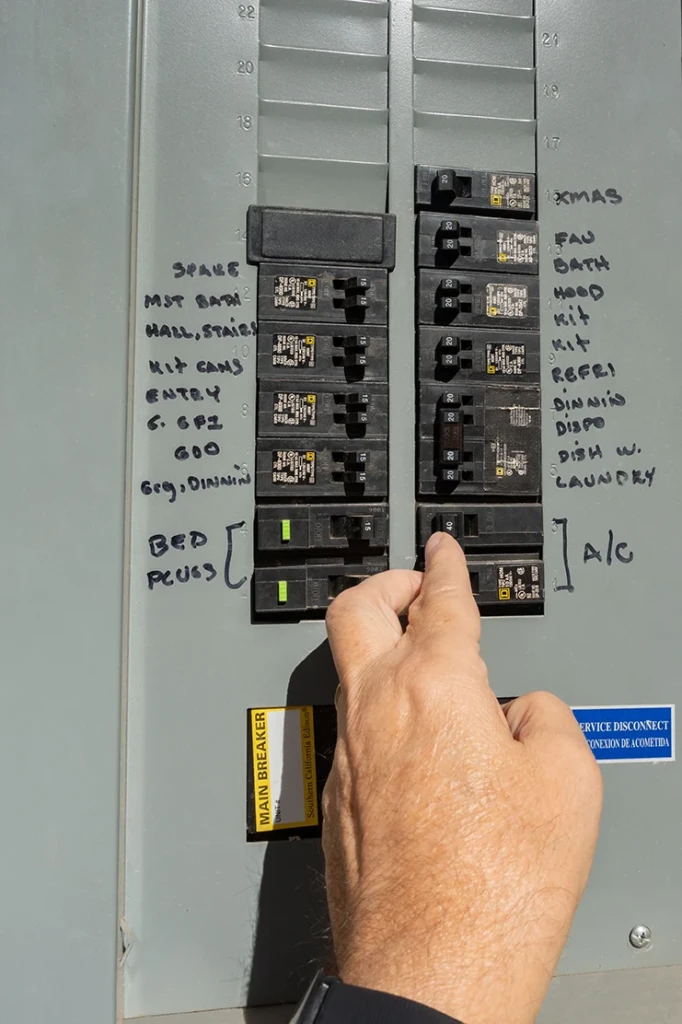
Follow one golden rule. Never swap in a bigger breaker just to stop the tripping. The wire inside your wall stays the exact same thickness, meaning you just removed the only safety net stopping it from melting. Need more power? Hire an electrician.
Not sure what shares your circuit? One breaker routinely feeds multiple outlets across totally different rooms, and the handwritten labels inside your electrical box are wrong half the time. Flip that breaker off, walk around plugging a lamp into nearby outlets, and see what went dead.
What does it actually cost to run?
This is what keeps buyers up at night. Running a TR-2 every other day costs under five bucks a month.
We pulled these figures from our full cost breakdown using the April 2026 US average of 18.83 cents per kilowatt-hour. We calculated a 15-minute warm-up plus a 45-minute session, assuming our heaters blast at 100 percent power the entire hour. They actually cycle down once warm, so treat these numbers as an absolute worst-case scenario.
| Sauna, every other day | Per session | Per month | Per year |
| TR-1 / TRS-1 | $0.18 | $2.75 | $33 |
| TR-2 / TRS-2 | $0.30 | $4.58 | $55 |
| TR-3 / TRS-3 | $0.36 | $5.44 | $65 |
| Traditional sauna, 6 kW heater | about $1.22 | about $18.60 | about $223 |
| Traditional sauna, 9 kW heater | about $1.85 | about $28 | about $335 |
Those traditional sauna costs even assume the heater drops to half power once the room gets hot. Honestly, that’s being pretty generous to them.
Your local electric rate might be higher or lower. Grab your power bill, find your price per kWh, and adjust from there.
What other sauna companies hide from the box
After a decade in this business, I know where brands hide the fine print. Watch out for these four traps.
- “Plugs into any outlet.” Maybe, maybe not. Read the actual spec sheet. Plenty of saunas slapping that claim on the box still demand a dedicated 20-amp line or more. The amp rating tells the truth. The big headline is just ad copy.
- Missing amp ratings. If a brand refuses to tell you how many amps their unit pulls, ask them directly. If they dodge the question, walk away.
- Selling higher wattage as “more power.” I’ll be honest, I used to fall for this trick myself. Higher watts don’t give you a better sweat. They just give you a fatter electric bill. What actually matters is how much heat reaches your skin, not how much electricity the heaters burn up.
- Bait-and-switch voltage. The tiny 1-person model runs on 120V, so you assume the whole lineup does. Wrong. Several brands jump to 240V once you size up. Check the specs for the exact model you’re buying, not the front page of the catalog.
Before your sauna arrives
- Pick your spot and trace which breaker controls that outlet.
- Buying a 2- or 3-person model? Unplug everything else on that circuit.
- Grabbing a 3-person unit without an open 20-amp line? Have an electrician add one. It’s way cheaper and easier than wiring 240V.
- Plug the cord straight into the wall. Ditch the extension cords and power strips.
- Check your ceiling height. Our units stand 77½ inches tall.
- Putting it in the garage? Totally fine, provided it stays dry. Just expect slower warm-ups during winter if your garage lacks insulation or heat.
That’s the whole story. No 240V rewiring, no expensive panel upgrades, and really not as much as you thought added to your monthly bill.
Still second-guessing your home’s setup? Give us a call. We’re happy to offer more info and troubleshoot any electrical needs or questions you have!
Keep reading

Morning vs. Evening Sauna: When Is the Best Time to Use an Infrared Sauna?
One of the questions we get most often from our sauna customers is, “Should I sauna first thing…
Does Sauna Therapy “Boost” Your Immune System? What a New 2026 Study Found
“Boosts immunity” is one of those phrases that gets used so often in wellness that it has almost…

7 Reasons to Add an Infrared Sauna to Your Gym or Fitness Studio
Modern fitness businesses increasingly have to think beyond equipment and workouts. Members care about the entire cycle: training…
Have a question an article didn’t answer?
Mon–Fri, 8am–5pm Mountain