Fresh air is more than a feeling. It can be measured.
In a closed cabin, part of every breath is air you already exhaled. Active ventilation keeps that part small. Across 15 logged sessions, it cut CO₂ buildup by 46%.
Measuring the air you've already breathed
Every breath you exhale carries almost 40,000 ppm of carbon dioxide, roughly 100 times more than outdoor air. In a small, closed cabin, that breath has nowhere to go. It mixes into the air you inhale next.
That makes CO₂ the most practical measure of stale air. People are the only meaningful source of it in a sauna, so the rise in CO₂ tracks how much exhaled air has built up. Ventilation engineers, and standards bodies such as ASHRAE, use it the same way: as a gauge of how well a space is ventilated.
What travels with exhaled air is what you notice: moisture, body odor, and the heavy, stuffy feel of a room that needs a window open. Some controlled studies have found slower decision-making at 1,000 to 2,500 ppm of pure CO₂; others haven’t. The more consistent evidence points at everything else in exhaled air, which is exactly what CO₂ tracks. Lower is better, and lower is measurable.
Still air starts to feel heavy. Fresh, moving air doesn’t.
That heaviness has a measurable source. In a Danish lab study, people breathing air loaded with exhaled bioeffluents reported more headache, fatigue, and sleepiness, and slowed on mental tasks. Pure CO₂ at the same level had no effect. The problem is exhaled air; CO₂ is how you measure how much of it there is.
Heat makes the same air feel worse. Lab studies find air feels less acceptable as it gets warmer and more humid, and people don’t get used to it. A sauna is far warmer and more humid than any of those labs.
Active ventilation works on both fronts. It keeps exhaled air from building up, by 46% in our tests, and it keeps bringing in fresh room air. That second part matters: in another Danish study, stirring a room’s own stale air around made it feel fresher but didn’t ease headache or fatigue. Moving fresh air did.
For anyone uneasy in small spaces, the air matters even more. Psychologists describe claustrophobia as two related fears: of being confined, and of not getting enough air. MRI suites, where claustrophobia is an everyday problem, keep air moving through the scanner as a standard comfort measure. We can’t measure how closed-in a cabin feels, but we can keep its air from getting stale.
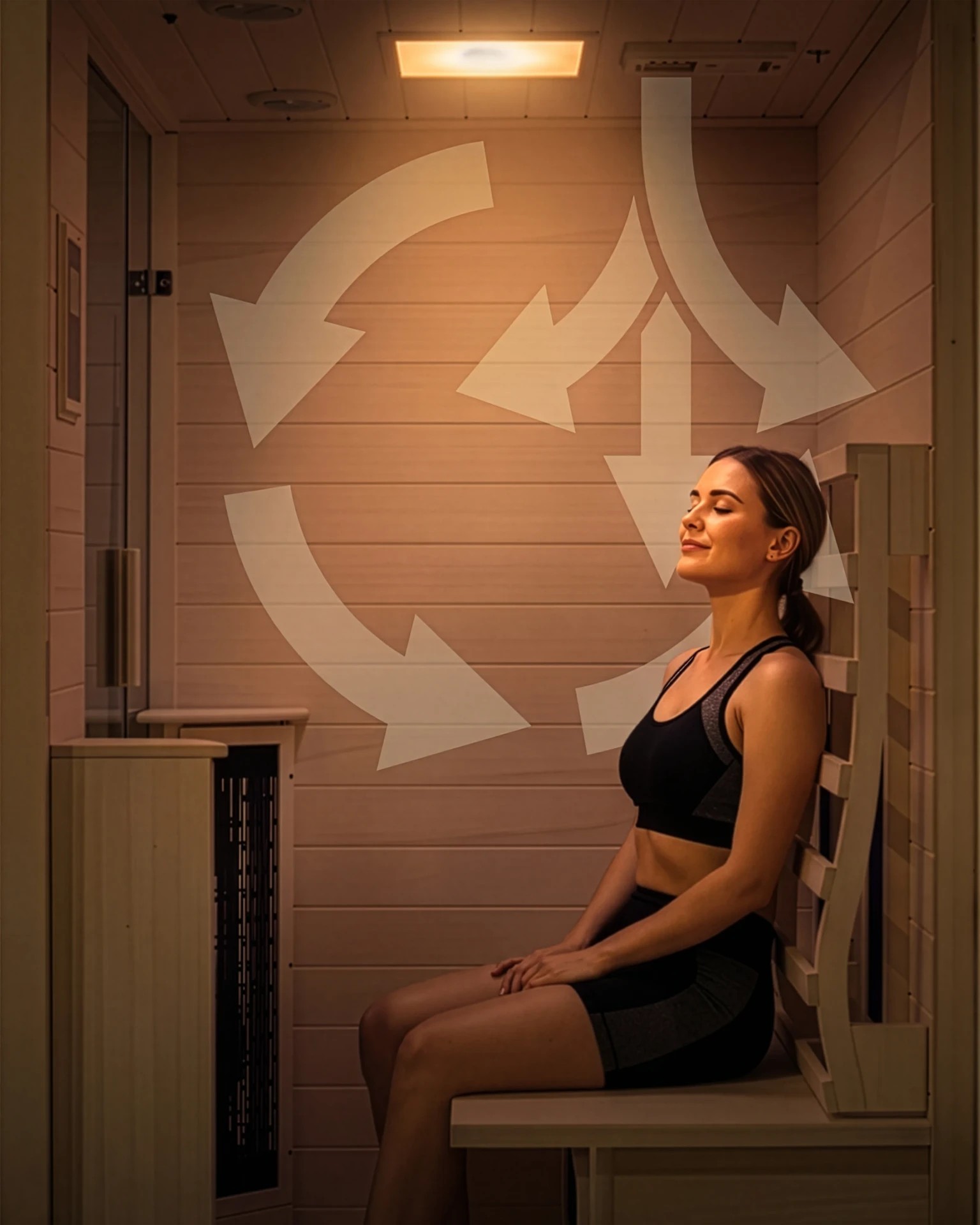
Two ways to change the air
A passive vent depends on physics it can’t control. Warm air drifts out the vent, and replacement air leaks in wherever it can, at a rate set by the cabin’s temperature and its gaps. In a well-built, tightly sealed cabin, that isn’t much.
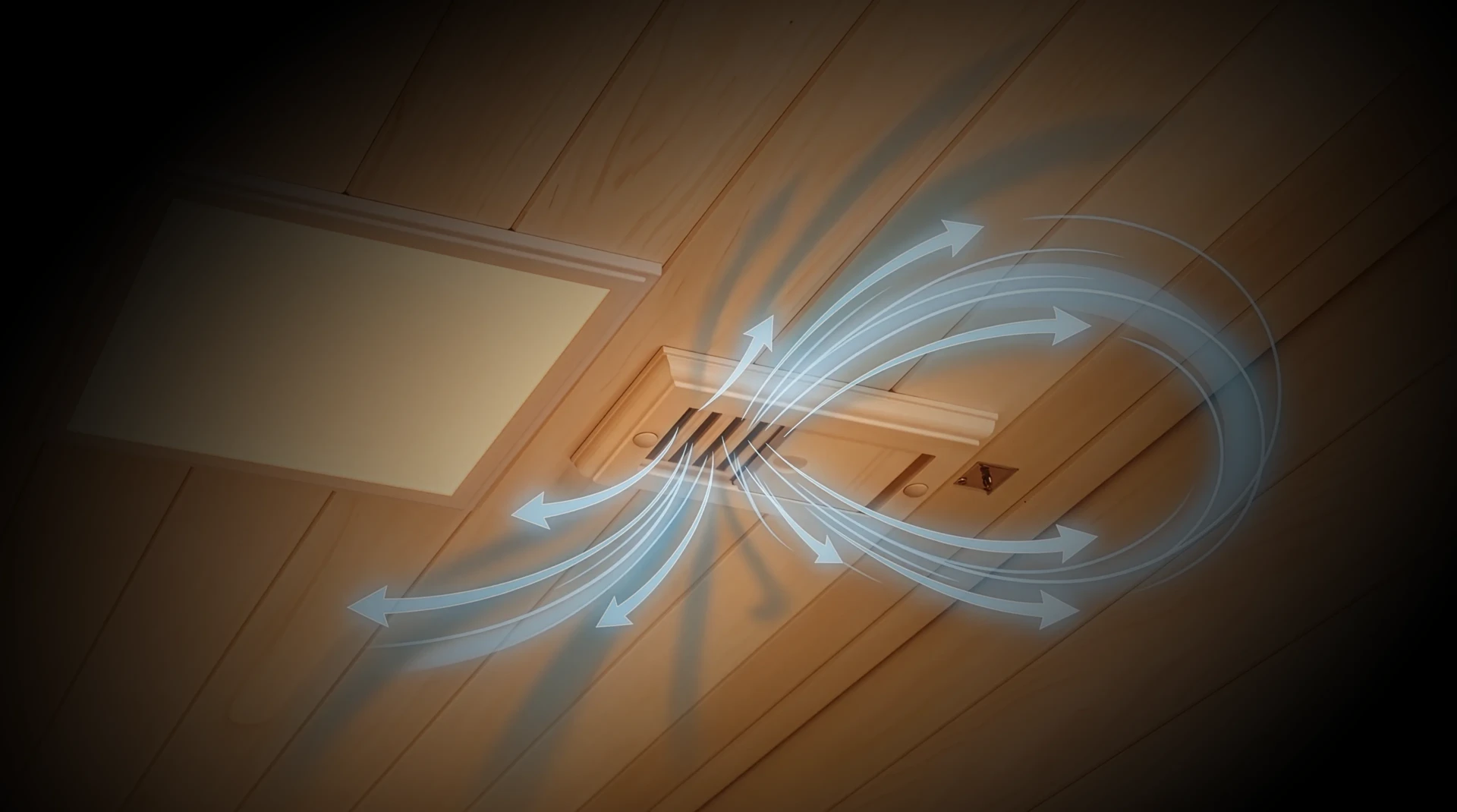
Active ventilation adds a quiet fan that moves a steady volume of air through the cabin. Fresh room air enters from the ceiling, mixing the hot air, and used air leaves low, near the floor, so the air you breathe keeps turning over. It’s the same principle a well-built home uses to keep indoor air fresh.
Every Transcend sauna, Foundation and Smart Series, includes active ventilation as standard, manually switchable from the controls.
Thirty minutes, fifteen sessions
We set a logging CO₂ meter inside a two-person Transcend sauna and recorded a reading every minute. The same adult man sat a 30-minute session on 15 days between March 24 and April 8, 2024, alternating fan on and fan off. Nothing else changed.
Occupant: one adult man, every session.
Different bodies exhale different amounts of CO₂. Using one person removes the largest source of variation.
Cabin: a two-person Transcend sauna.
Same cabin in the same room, door closed for all 30 minutes.
Schedule: alternating days.
Fan on and fan off traded days for 16 days, so slow changes in season or room air affected both settings alike.
Start: a room-temperature cabin.
Each session began as the heaters switched on. One fan-on session started in a preheated cabin and was excluded; including it gives the same 46%.
Instrument: one NDIR CO₂ meter, the same unit every session.
A Tekcoplus COTK-57, factory calibrated, logging once a minute at top of left front heater. Rated accuracy is ±50 ppm or ±5% of the reading up to 2,000 ppm, and ±10% above. Its CO₂ sensor responds in under 30 seconds, well inside the one-minute interval, and the cabin stayed within its rated operating range: peak air 110°F against a 122°F limit.
Fan off: passive vent open, as shipped.
The comparison is active ventilation against the passive ventilation every cabin has, not against a sealed box.
Metric: rise above each session's own start.
Room CO₂ ranged from 474 to 720 ppm at the start of a session, so we measure what each session added.
CO₂ Rise Above Starting Level, Both Settings.
Half the buildup, minute after minute
Both settings start the same way. CO₂ climbs fast for the first few minutes as the first breaths fill the cabin. Then the curves split.
With passive ventilation, CO₂ kept climbing, reaching 1,487 ppm above its starting level by minute 30. With active ventilation, it leveled off at 790. From minute 6 to the end, the buildup stayed 46% to 50% lower at every one-minute reading.
Fifteen sessions, no overlap
Exact Mann–Whitney test on the 15 session averages: p = 0.0003. Chance alone would produce a split this clean about 3 times in 10,000.
How 46% is calculated
46% is the average of the 30 one-minute values, minutes 1 through 30. It includes the first minutes, when both cabins are still filling and the gap is small (16% at minute 1). Measured by total buildup across the session instead, the reduction is 47%. We publish the lower number.
Why rise, not raw ppm: Room air on fan-off days happened to start 91 ppm higher on average (645 vs 554 ppm). Comparing raw readings would credit the fan for a fresher room. Subtracting each session’s own starting level removes that.
Why a ±5% meter can support a 46% result: An accuracy rating describes how far a single reading could sit from the true value. Our result compares two rises measured by the same meter. If the meter reads 50 ppm high, that offset cancels when each session’s starting reading is subtracted. If it reads 5% high, both rises grow by 5% and their ratio doesn’t move. The rating widens above 2,000 ppm, where nearly half the fan-off readings fell; even if every one of them overstated its excess above 2,000 by the full 10%, the result would still be 45%. The harshest case, a meter that read high by its full rated error on every fan-off day and low by its full rated error on every fan-on day, would still leave a 38% reduction.
| Minute |
Passive ventilation, rise (ppm) |
Active ventilation, rise (ppm) |
Lower by |
|---|---|---|---|
|
5 |
920 |
520 |
43% |
|
10 |
1,261 |
625 |
50% |
|
15 |
1,377 |
700 |
49% |
|
20 |
1,422 |
742 |
48% |
|
25 |
1,464 |
770 |
47% |
|
30 |
1,487 |
790 |
47% |
|
Average of all 30 one-minute values |
|
|
46% |
Half as much rebreathed air
CO₂ converts into something more intuitive: the share of each breath you already exhaled during the session. Harvard researchers Rudnick and Milton published the method in 2003. It divides the CO₂ rise by the CO₂ a breath adds, about 38,000 ppm.
With passive ventilation, about 1 part in 26 of every breath had already been through your lungs by the end of the session. With active ventilation, about 1 in 48.
At minute 30. Rebreathed share = CO₂ rise ÷ 38,000 ppm (Rudnick & Milton, Indoor Air, 2003). Assumes well-mixed cabin air.

About 3 °F of air temperature
Fresh air in means warm air out. In the same sessions, cabin air rose 29 °F over 30 minutes with active ventilation and 32 °F without, a difference of about 3 °F by the end.
That trade matters far less in an infrared sauna than in a traditional one, which heats you with hot air. Infrared warms you by radiant energy, which is why we test our heaters by the energy they deliver to water, not by air temperature. How we measure our heaters. Those heater tests ran with active ventilation off, so each result stands on its own.
Prefer warmer air? Turn active ventilation off from the controller / touchscreen at any point in a session.
What this test shows, and what it doesn’t
- One occupant. These results are for one adult man in a two-person cabin. A larger or more active person exhales more CO₂, and both curves would sit higher.
- Two occupants. Two people exhale roughly twice the CO₂. Because the fan’s advantage comes from airflow, we expect a similar percentage reduction, but we haven’t published two-person data yet.
- Moisture. Our logger also recorded humidity. Sweat varies too much from day to day for this test to put a number on moisture removal, so we don’t claim one.
- Your room. The fan draws air from the room around the sauna. A well-ventilated room gives it fresher air to work with.
Rudnick & Milton, Indoor Air 2003
Exhaled breath near 40,000 ppm CO₂; rebreathed share = CO₂ rise ÷ 0.038.
Satish et al., Environmental Health Perspectives 2012
Decision-making effects at 1,000 and 2,500 ppm; the authors called for replication.
Submariner decision-making study, Aerospace Medicine and Human Performance
No effect found at 2,500 or 15,000 ppm.
ASHRAE Position Document on Indoor Carbon Dioxide, 2025
ASHRAE sets no indoor CO₂ limit; CO₂ indicates outdoor-air ventilation per person, tied to body-odor perception, and evidence of direct cognitive effects is inconsistent.
Fang, Clausen & Fanger, Indoor Air 1998
Air feels less acceptable as temperature and humidity rise, with no adaptation over 20 minutes.
Melikov & Kaczmarczyk, Building and Environment 2012
Moving air improves perceived freshness, but only clean, cool air eased symptoms.
Radomsky et al., 2001, Claustrophobia Questionnaire
Claustrophobia comprises fear of suffocation and fear of restriction.
University of Toledo Medical Center, MRI claustrophobic patients policy
A fan circulating air in the scanner is a standard comfort measure.