Infrared sauna questions, answered
Answers from the family-owned team that has designed far infrared saunas in Boulder since 1997 — on heat, health, sessions, EMF, wood and the Transcend Smart Sauna.
On this page8 sections
The basics
How does far infrared heat differ from traditional sauna heat?
Far infrared heat penetrates directly into body tissues, so it works at lower, more comfortable temperatures than a traditional sauna’s hot air.
Why choose a far infrared sauna over other types?
Far infrared saunas offer the most researched and safest form of infrared therapy, providing optimal benefits at comfortable temperatures without the potential risks associated with other infrared wavelengths.
Are far infrared saunas safe for regular use?
Yes, for most people, when you follow the usual guidelines: start with short sessions, drink water, and stop if you feel unwell. Far infrared gives gentle heat without the risks of extreme temperatures or other infrared wavelengths. If you are pregnant, have a heart condition, or take medicine that affects how you handle heat, check with your doctor first.
Will I sweat as much in a far infrared sauna as in a traditional sauna?
Yes, you’ll likely sweat as much or more, but the sweat is produced through direct body heating rather than from hot air, making it a more comfortable experience.
Can far infrared saunas be used outdoors?
It’s possible, but they work best indoors, where temperature and humidity can be controlled. Sauna wood is chosen to give off as little as possible, so it should have little or no treatment. Outdoors, the wood would need either a protective enclosure or a weatherproofing treatment — and that treatment would off-gas when the sauna heats up.
Can I use electronic devices in a far infrared sauna?
Because the air is cooler, most devices work just fine in an infrared sauna.
Can I use essential oils in my sauna?
Yes! Follow this guide:
Health and safety
Who should check with a doctor before using a sauna?
Talk to your doctor first if you are pregnant; have a heart condition, low blood pressure or a history of fainting; or take medicine that affects how your body handles heat. The same goes if you are recovering from an injury or surgery.
Can I use a far infrared sauna if I’m sensitive to heat?
Yes! Far infrared saunas are ideal for heat-sensitive people because they work at lower temperatures while still providing the benefits. Start at the low end of the range and build up.
How does far infrared sauna use affect blood pressure?
Far infrared saunas may help support healthy blood pressure through improved circulation. However, always consult your healthcare provider, especially if you have blood pressure concerns.
Can far infrared saunas help with chronic pain?
Many people report less chronic pain, from the deep heat and better circulation, and small studies in arthritis and fibromyalgia have found the same. The gentle warmth can help relax muscles and reduce inflammation.
Is it safe to use a sauna while recovering from an injury?
While far infrared heat can support recovery, always consult your healthcare provider about using a sauna during injury recovery.
Do far infrared saunas boost the immune system?
Regular sessions may support immune function. Heat increases circulation and the production of heat shock proteins, which help cells repair themselves, and a long-term Finnish study found less respiratory disease in people who used a sauna often.
Can far infrared saunas help with skin conditions?
Many people notice healthier skin, and studies have found better skin hydration and blood flow with regular sessions.
Using your sauna
How long should my sauna sessions be?
Start with 10–20 minute sessions and gradually increase to 30–40 minutes as your body adapts. Listen to your body and stay within your comfort zone. A Transcend Smart Sauna takes the guesswork out: it starts new users slowly, builds up using medical-standard protocols, and helps you schedule sessions on the days and for the lengths that give you the most benefit.
How often can I use a far infrared sauna?
Most people can safely use a far infrared sauna 3–4 times per week. Some enjoy daily sessions once they’re used to the heat. The largest studies of sauna use found the strongest results at four or more sessions a week.
What’s the ideal temperature for a far infrared session?
Between 100°F and 140°F, with most people most comfortable at 120°F to 130°F. Our saunas cap sessions at 158°F for safety. Some companies advertise higher settings, but an infrared sauna gains nothing by getting hotter — all the benefits come at much lower temperatures.
How long does a far infrared sauna take to heat up?
Quality far infrared saunas reach their temperature in about 10–15 minutes, much faster than traditional saunas.
How long before I see improvements?
You will notice some improvements from your very first session. Others take a few sessions, or a few weeks.
Do I need to prepare differently than for a traditional sauna?
While both require proper hydration, far infrared sessions are generally more comfortable and require less preparation. However, staying well hydrated remains essential.
How soon after eating can I use the sauna?
Wait an hour or so after a full meal, though light snacks are generally fine 30 minutes before. Make sure you feel comfortable before you go in.
What should I wear in a far infrared sauna?
Light, loose-fitting clothing or a towel is appropriate. Some people prefer minimal clothing or none, to maximize infrared absorption.
What should I drink before and after?
Drink plenty of water before, during (if needed), and after. Electrolyte drinks can help, especially for longer sessions or more than one session a day.
Can I exercise before or after using the sauna?
Light exercise before is fine, but wait at least 15 minutes after exercising before you use the sauna. After a session, wait until your body temperature is back to normal before exercising.
Should I shower before or after a sauna session?
A quick rinse before is optional. A shower afterward is recommended, to wash off the sweat — use warm, not hot, water and a mild soap.
How do I clean and look after my sauna?
Very little is needed. Now and then, wipe the surfaces with a natural cleaner and a clean cloth, and avoid harsh chemicals and abrasives. Keep the sauna dry when you aren’t using it, and make sure the room it’s in is well ventilated.
How long will my sauna last?
A quality far infrared sauna can last 15–20 years or more with proper care.
Our heater, where effects begin, and a typical sauna
Low EMF
What makes High Tech Health saunas low EMF?
Our saunas reduce both electric fields and magnetic fields. Many saunas sold as “low EMF” reduce only the magnetic field, and don’t publish the electric field at all. Our patented Clean Heat™ technology (U.S. Patents 9,770,386 and 10,765,597), together with mitigated wiring, brings both down.
Why are electric fields as important as magnetic fields?
Both have been shown to affect cells the same way: by forcing calcium into brain and heart cells. In the brain, that can disrupt the release of neurotransmitters and hormones, and people with long-term exposure report trouble sleeping, headaches, low mood, anxiety, fatigue, poor concentration and memory changes. Most saunas only address magnetic fields, which can leave you in electric fields as high as 2,000–3,000 V/m. We address both.
What is “ELF”, and how does it relate to EMF?
ELF stands for “extremely low frequency” — in the United States, the 60 Hz of the power grid. The term covers both ELF electric fields and ELF magnetic fields. Some companies advertise “low ELF” when they have only partly reduced the electric field, while their saunas still give off high EMF. We reduce both the electric and the magnetic field.
How do I check a sauna company’s EMF claims?
Look for independent testing that measures both electric and magnetic fields, at the heater surface or where your body actually sits. Be wary of companies that only give magnetic field data, test far from the heaters, or test a heater at a different voltage from the one in their saunas. We publish our test in full.
How low are the fields in a High Tech Health sauna?
An independent engineering firm, Vitatech Electromagnetics, measured our heater at 0.089 V/m for the electric field and 0.40 mG for the magnetic field, 8 cm from its surface — about where you sit. Research has reported effects on cells starting around 300 V/m and 2–3 mG.
Can EMF exposure affect my detox results?
It may. High electric and magnetic fields create oxidative stress, which uses up the antioxidants your body relies on to deal with toxins — working against the reason you’re in the sauna.
Why do EMF levels matter during a sauna session?
Studies have reported effects on cells at magnetic fields as low as 2–3 mG and electric fields under 300 V/m. In a typical infrared sauna without proper mitigation, you may be exposed to electric fields of 2,000–3,000 V/m and magnetic fields as high as 2,000 mG or more. Because you’re surrounded by high-power heaters, an ordinary sauna can be the strongest EMF exposure of your day.
What are the health risks of EMF exposure in saunas?
Long-term EMF exposure has been linked to trouble sleeping, low mood, anxiety, fatigue and poor concentration. Research has also found oxidative damage, faster cell aging and DNA breaks, and the International Agency for Research on Cancer classifies low-frequency magnetic fields as possibly carcinogenic. If you use a sauna for your health, high EMF works against the reason you’re in it.
Heaters and air

Why do sauna heaters matter?
Carbon heaters are usually large panels that give less focused heat. All-metal heaters can give more intense heat, directed toward your body. The heater decides how much far infrared reaches you, how evenly, and how strong the fields around you are.
What are Ideal Spectrum™ heaters?
Our patented, all-metal heaters, designed to give off far infrared with low EMF. Independent calorimetry measured them 34% more effective than other heater designs, so they warm you faster and use energy more efficiently.
What are Triple Antifield™ heaters?
Our patented heaters with Clean Heat™ EMF mitigation. They are designed to reduce both the electric and the magnetic field a heater gives off. U.S. Patents 9,770,386 and 10,765,597.
Why are your heaters 34% more effective?
Independent calorimetry testing found that our Ideal Spectrum™ heaters deliver 34% more effective infrared output than standard carbon panel heaters. Your body temperature rises more quickly, so you get more from each session.
Is your heater technology patented?
Yes. Our heater technology is protected by U.S. Patents 9,770,386 and 10,765,597. We pioneered heaters that reduce both electric and magnetic fields, and we keep developing them.
How do I know a sauna is really producing far infrared heat?
Quality far infrared saunas use heater materials with high emissivity. Unlike near infrared heaters, which glow red, far infrared heaters don’t change color while they run — but you will feel the heat from them.
How much electricity does a far infrared sauna use?
They’re generally energy efficient — about the same power as a hair dryer while running.
What is active ventilation, and does my sauna need it?
Far infrared saunas need less ventilation than traditional saunas, because the air is cooler. But in any closed cabin, carbon dioxide builds up quickly. Active ventilation — standard in every High Tech Health sauna — keeps swapping the air inside for fresh air from outside, cutting carbon dioxide by 46% compared with passive vents. The air stays fresh and the session stays comfortable.
Sauna wood



Why does wood choice matter in a sauna?
Heat makes poor-quality wood give off chemicals. Treatments, glues and some woods’ own natural compounds can off-gas when warm, causing breathing irritation, headaches, allergic reactions, eye and skin irritation, and worse symptoms for people with chemical sensitivities or asthma. We use only solid, low-VOC woods, with no toxic treatments.
What woods do you offer?
Three: Poplar, the choice for chemical sensitivity; Canadian Hemlock, for a more traditional look; and Okoume, a West African hardwood with a warm reddish-brown color. All are sustainably sourced and low-VOC, with no chemical treatments, formaldehyde-based glues or toxic stains. Every sauna is built from a single wood — no mixed woods and no plywood.
What is Poplar, and who should choose it?
Poplar is the most expensive sauna wood we use, and the one health clinics choose, because it has almost no odor and is the best tolerated by people with chemical sensitivities. The Environmental Health Center in Dallas, founded by the late Dr. William Rea, uses only Poplar saunas. If you’re chemically sensitive or dealing with environmental illness, Poplar is the wood we recommend.
What is Hemlock, and who should choose it?
Hemlock has a more visibly defined grain and a very slight wood character, giving a more traditional wood-sauna experience. Our analysis found aged Canadian Hemlock much lower in formaldehyde than cedar, with a lower VOC profile. It costs less than Poplar, so it’s a way to save while still getting our low-EMF design. Hemlock is not recommended if you are chemically sensitive.
What is Okoume, and who should choose it?
Okoume (Aucoumea klaineana) is a West African hardwood with a fine, even texture and a warm reddish-brown color — a good choice if you want a richer look. Elsewhere in the sauna industry it’s usually sold as plywood or veneer, and often marketed as “mahogany”. We use it the way we use every wood: 100% solid boards, with no plywood and no veneer. If you’re chemically sensitive or dealing with environmental illness, choose Poplar instead.
Do you use plywood?
No. We use 100% single-wood construction only. We never use plywood, engineered wood or mixed woods, which contain glues and adhesives that off-gas when heated. Most budget saunas from large online retailers, hardware stores or big-box stores use a lot of plywood.
Why don’t you use cedar?
Cedar contains terpenes that vaporize when heated and are known respiratory irritants. Many people tire of the smell filling their home, and some develop allergies. Cedar resists moisture and insects, but an infrared sauna doesn’t have a traditional sauna’s moisture problems, so it doesn’t need those properties.
Why don’t you use basswood?
Basswood was introduced by other companies to imitate our Poplar saunas at a lower cost. It has a peculiar odor many people dislike, and every basswood sauna we know of uses spruce for its frame — so it can’t be called hypoallergenic.
How can I tell if a sauna is made with safe wood?
Ask whether the cabin is solid wood all the way through, with no plywood or engineered panels; what finishes, glues and treatments are used; and what the hidden framing is made of. Ask for VOC test results. No wood gives off nothing, so the question is how little — and a company that claims zero off-gassing or zero VOCs is not being straight with you.
What should a quality sauna smell like?
You should only notice a mild, natural wood scent. Any strong, chemical or artificial smell is a red flag for toxic materials.
How long does it take a new sauna to off-gas?
A sauna built from the right materials should need little or no off-gassing period. Every wood gives off something when heated, but it should be slight from the start. If a manufacturer suggests a long “break-in” period, that can point to poor materials.
Are there woods to avoid in saunas?
Avoid pressure-treated wood, engineered wood, and any wood treated with chemical preservatives, stains or varnishes that could give off toxins when heated.
How does wood quality affect people with Multiple Chemical Sensitivity (MCS)?
If you have MCS, consider only the highest-quality, chemical-free woods. Even a little off-gassing can trigger a severe reaction. That’s why we recommend Poplar.
The Transcend Smart Sauna

A 10.1″ touchscreen in every Smart Sauna.
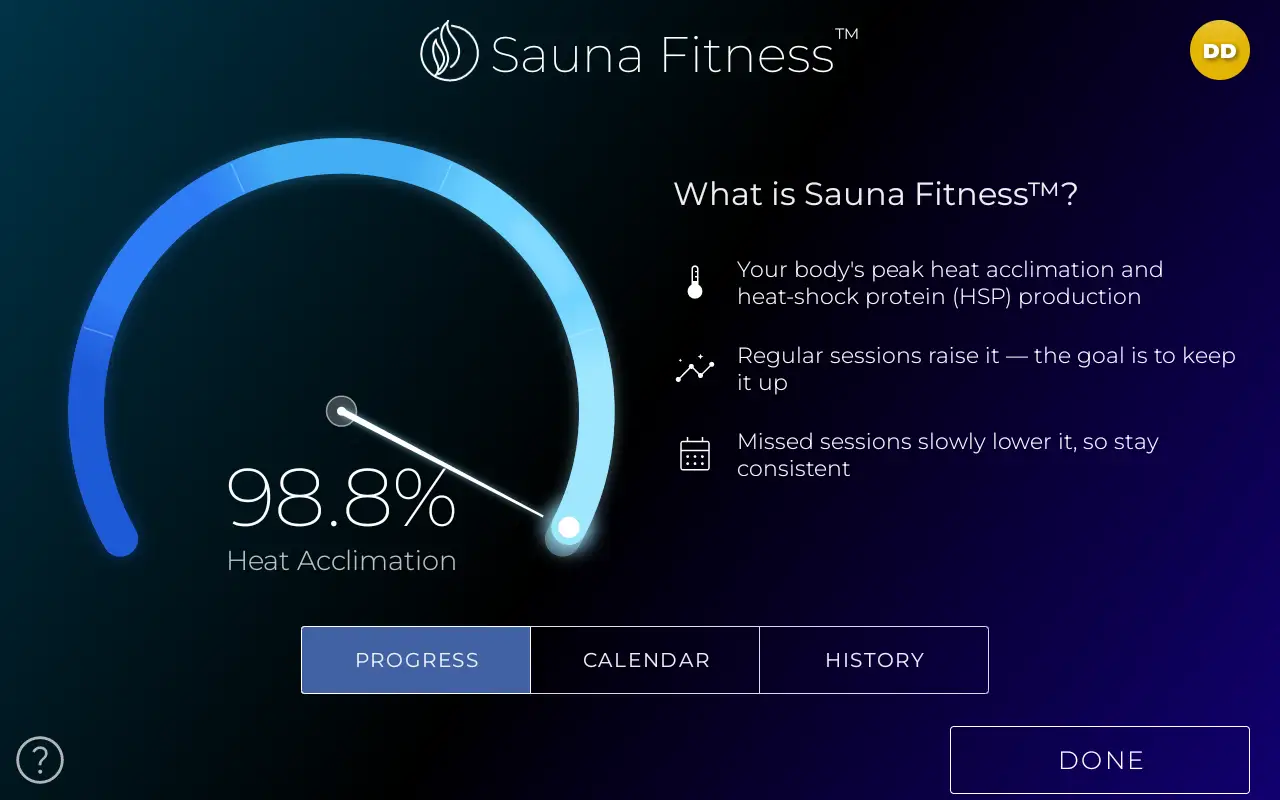
How well you’ve adapted to heat.
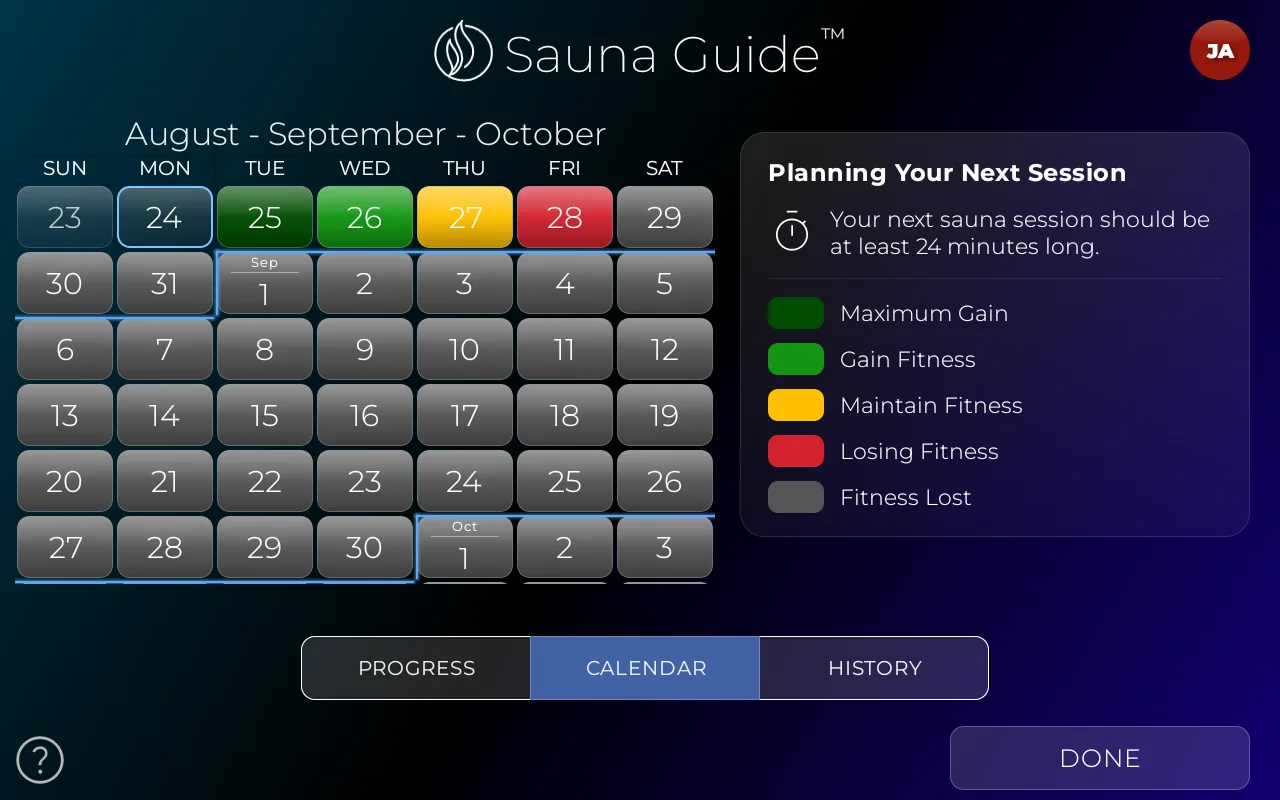
When your next session helps most.
What is a Smart Sauna?
The Transcend Smart Sauna combines our low-EMF heaters with features that personalize every session: Sauna Fitness™ tracking, the Sauna Guide™ calendar, app control, voice commands, guided breathing and entertainment. Our patent-pending Smart EMF Mode™ keeps wireless signals off while you’re inside.
How is the Smart Sauna different from the Foundation Series?
It has everything in the Foundation Series — low EMF, heaters measured 34% more effective, active ventilation, chromotherapy and premium audio — plus Sauna Fitness™, Sauna Guide™ recommendations, app and voice control, guided breathing, session scheduling, usage history and a 10.1″ HD touchscreen.
What is Smart EMF Mode™?
Our patent-pending feature that turns off Wi-Fi, Bluetooth and every other wireless signal during your session, when you don’t need them. You can also use the wired Ethernet connection instead. You stay connected without the radio-frequency exposure. It doesn’t change the heaters’ electric and magnetic fields — those are kept low by the heaters themselves.
Can I control my Smart Sauna remotely?
Yes! Start your sauna from anywhere using our app — leaving the office, finishing a workout, or just downstairs — and it will be ready when you arrive. You can also get temperature notifications, schedule sessions days in advance, and follow your progress on your phone.
Does the Smart Sauna have voice control?
Yes. Adjust the sauna by voice, without lifting a finger or opening your eyes. Commands are processed in the sauna itself — no data is ever sent over the internet. It’s also ideal for people with low vision.
What entertainment features are included?
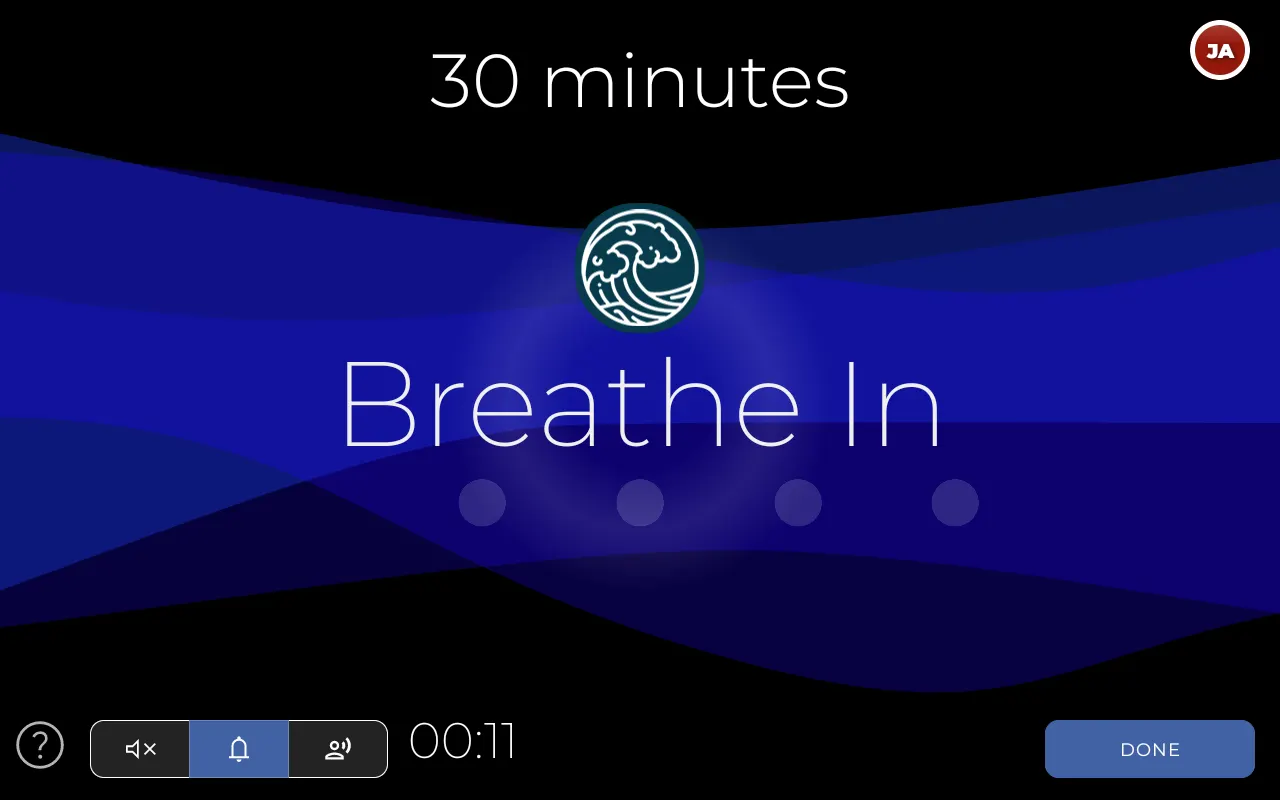
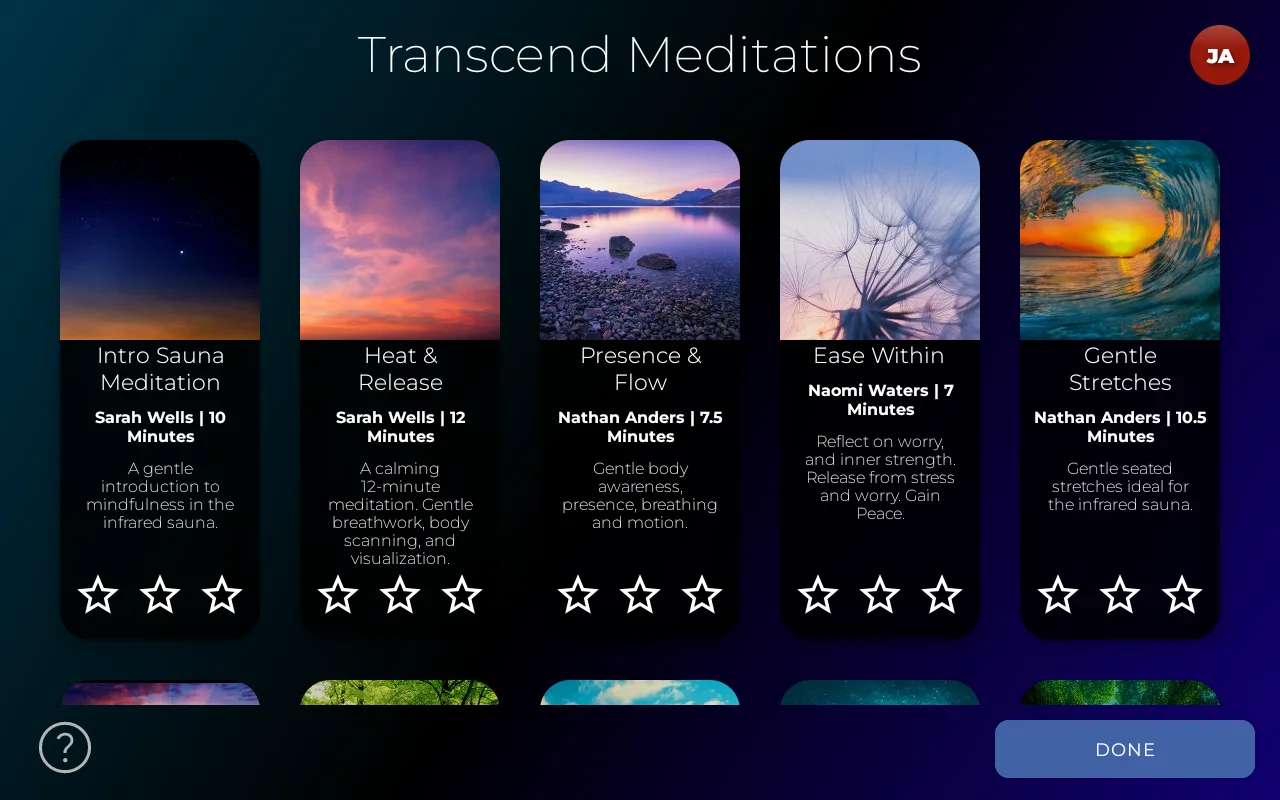
Bluetooth audio with on-screen playback controls (song, artist and album), guided breathing, meditation programs, chromotherapy lighting, Ambient Soundscapes, YouTube, Amazon Music, and a patent-pending tablet holder for streaming video. New apps and activities are added over time.
Can I schedule sessions in advance?
Yes! Schedule multiple sessions days in advance. You can even wake up to a warm sauna by setting it to preheat before you get up.
What is the Sauna Guide™?
The Sauna Guide™ predicts how your body will respond to each session, using a model we built from more than 100,000 sessions in our own saunas and our experience since 1997. It recommends settings for every session, and shows when your next session will do you the most good. It’s a prediction, not a sensor: nothing touches you.
How does the Sauna Guide™ help beginners?
For first-time sauna users, the Sauna Guide makes starting simple. It recommends settings tailored to you for every session, so you don’t need any expertise to get it right.
What does the Sauna Guide™ offer experienced biohackers?
It quantifies your progress, records a detailed history of every session, and helps you reach — and keep — a level of heat adaptation you couldn’t track before.
What is Sauna Fitness™?
A patent-pending index we developed that estimates how well your body has adapted to heat — your heat acclimation — from your sessions. It shows how effectively you’re building the benefits of regular sauna use, and how that changes over time.
How is Sauna Fitness™ calculated?
From our research into how the body adapts to heat. From the predicted rise in your core temperature and your pattern of use, it estimates your percentage of heat acclimation. Heat acclimation goes hand in hand with the production of heat shock proteins, one of the main ways regular sauna use benefits your cells.
Can I track my Sauna Fitness™ over time?
Yes! The Smart Sauna records your full usage history and shows your Sauna Fitness™ over time, with graphs showing how it rises with regular use and falls when you take a break.
About High Tech Health
How long has High Tech Health been making saunas?
Since 1997. The company began in water filtration, and in 1997 we designed our first far infrared saunas, the Thermal Life models. Decades of work with doctors, and with environmentally ill patients, have shaped how we design.
Why do doctors and health practitioners recommend you?
More than 6,000 health practitioners refer their patients to us, and we’ve been featured in more than 40 health books by doctors. Our team includes a medical doctor, a chiropractor, a holistic health practitioner, a nutritionist, a biochemist, a biologist, an electrical engineer and a psychotherapist.
Is High Tech Health environmentally responsible?
Yes! We’ve been carbon-negative since 2010. We offset the greenhouse gas emissions from making and shipping our saunas by partnering with organizations such as the Bonneville Environmental Foundation. Our heaters use much less electricity than standard panels, and our LED chromotherapy lighting keeps power use low.
What makes High Tech Health different?
Low EMF, measured in both electric and magnetic fields, with the report published. Patented heaters measured 34% more effective. Active ventilation in every sauna. The Smart Sauna’s Sauna Fitness™ and Sauna Guide™. Materials chosen for people with chemical sensitivities. A team of health professionals and scientists. And more than 6,000 practitioners who refer their patients to us — since 1997.