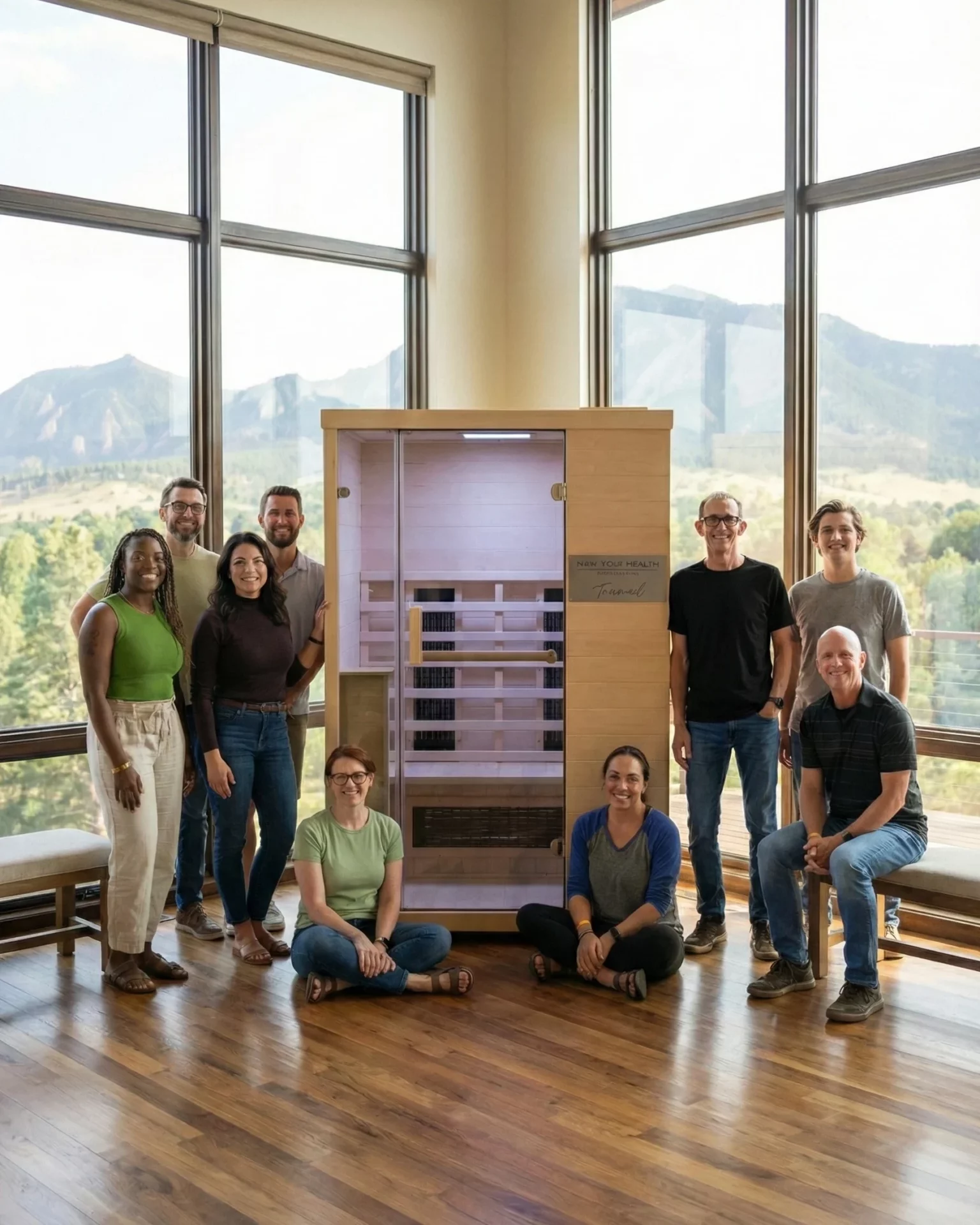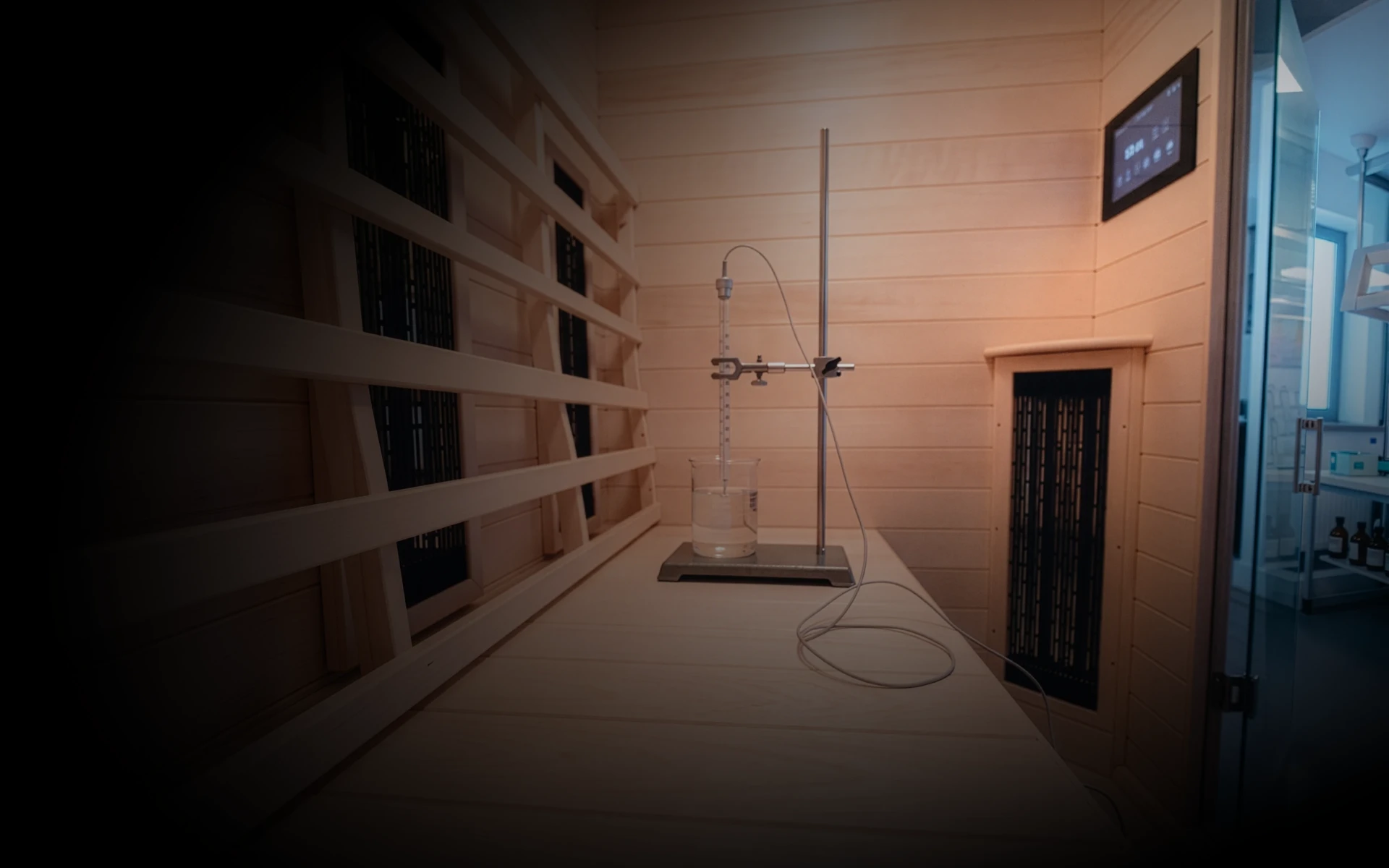
We measured it in water, because you are mostly water.
Starting from the same air temperature, with both heaters at full power, a beaker of water in a Transcend sauna absorbed 34% more energy in fifteen minutes than one in a leading panel-heater sauna. Here’s the method, every number we recorded, and what the test does and doesn’t show.
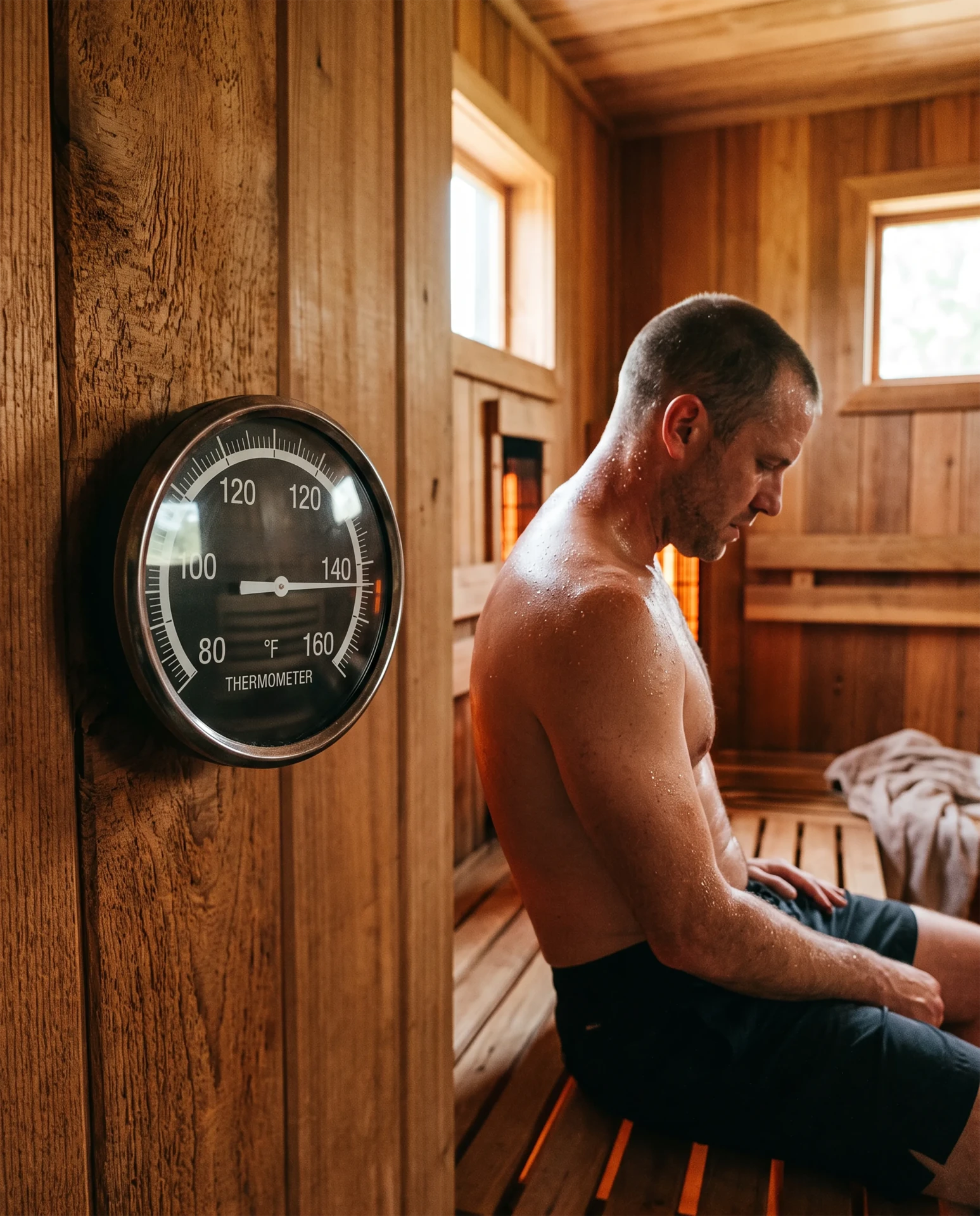
Two saunas can both read 100 °F and warm you differently
Saunas are usually compared by air temperature, because it’s easy to measure and almost any cabin will reach a given number if the heater runs long enough. But an infrared sauna works through radiant energy your skin absorbs, not through hot air. Two cabins at the same air temperature can deliver measurably different amounts of energy to the person inside. That difference is what a session is really about, so that’s what we measure.
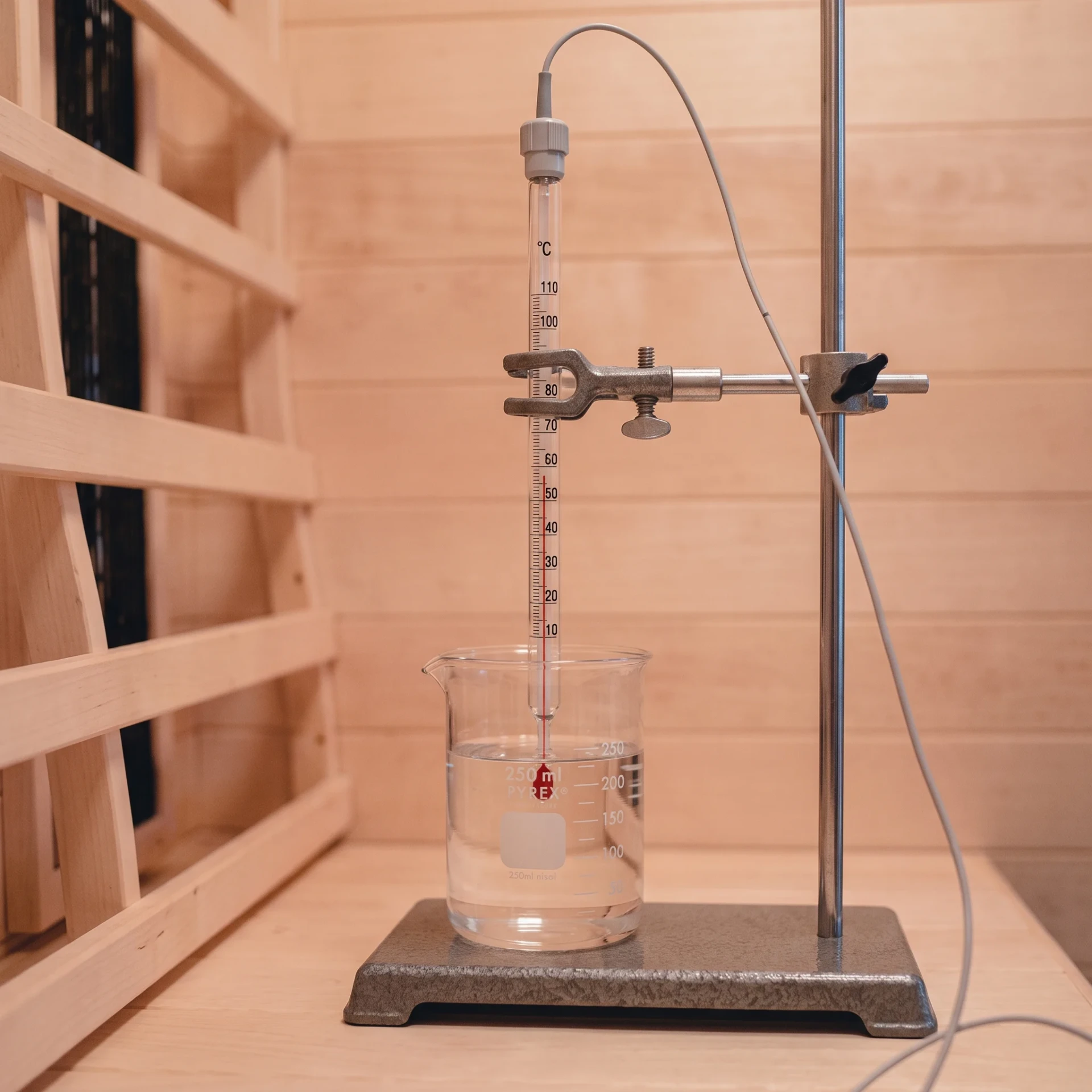
Why a beaker of water
Two saunas, one set of equipment, fifteen minutes each
We compared a Transcend TR-2 two-person sauna with a leading two-person panel-heater sauna. Panel heaters are the design most competing brands use, and they’re easy to recognize: flat heaters covering large areas of the interior walls. You can spot them in any product photo.
We tested the saunas back to back on the same day and the same electrical circuit, moving a single beaker, thermometer and camera from one cabin to the other. Then we placed the two time-lapse recordings side by side, lined up at the start of each run, so you can watch both readings at once.
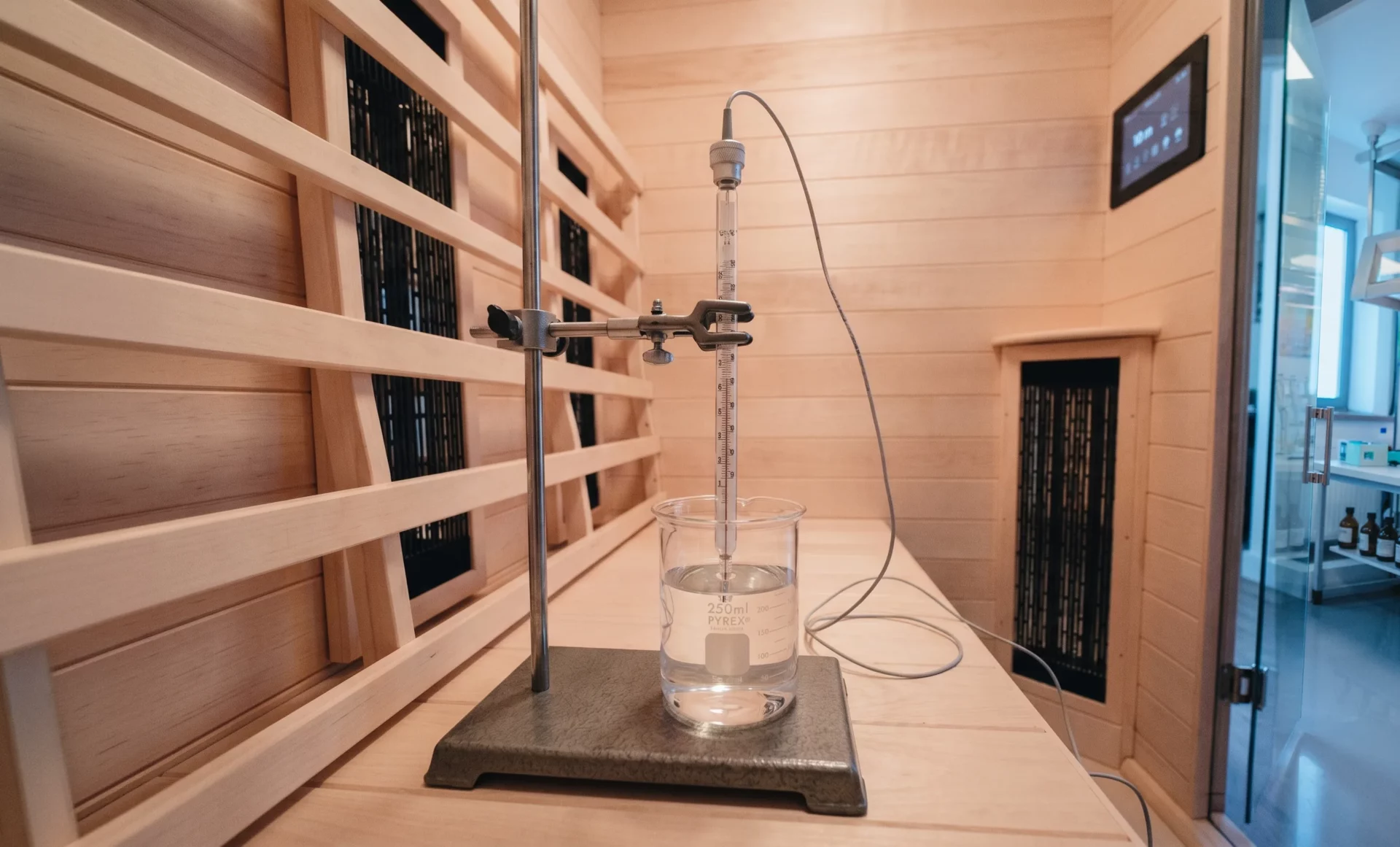
Two continuous time-lapse recordings, made back to back with the same equipment and shown side by side.
What we kept the same
Air temperature: 100 °F on each control panel.
Each sauna was brought to 100 °F, as reported by its own control panel, before the beaker went in. The air kept rising from there in both cabins.
Water: 1,000 g in the same 1,000 mL borosilicate glass beaker.
Starting temperatures were 70.07 °F and 70.01 °F, within 0.1 °F of each other.
Position: against the backrest.
Same height and orientation to the heater, with the probe at the same depth in the water in both runs.
Heaters: full power, start to finish.
Both temperature limits were set to maximum, so neither heater cycled off. A thermostat holds a set temperature by switching heaters off and on, and we wanted to measure the heaters, not the thermostats.
Thermometer: calibrated RTD, ±0.1 °C (±0.18 °F).
A Cole-Parmer Traceable® high-accuracy digital RTD thermometer with NIST-traceable calibration, displaying to 0.01 °F. Its display is in frame throughout both recordings.
Same instruments in both cabins.
The same beaker, probe and camera moved from one sauna to the other. Because we measured temperature rise with one probe, any fixed calibration offset cancels out of the comparison.
Power: same circuit, same day.
Rated heater power: Transcend 1,620 W; comparison sauna 1,690 W.
Cabin size: similar, Transcend slightly larger.
Interior dimensions: Transcend 45 × 41 × 70 in (about 75 cu ft); comparison sauna 45 × 36.5 × 72.5 in (about 69 cu ft).
Vents: closed in both.
Active ventilation switched off in the Transcend.
Duration: fifteen minutes from a matched start.
Water Temperature Rise, Both Beakers
34% more energy reached the water
How 34% is calculated
| Feature |
A leading panel-heater sauna |
Transcend |
|---|---|---|
|
Water |
1,000 g |
1,000 g |
|
Start |
70.07 °F |
70.01 °F |
|
After 15 min |
72.75 °F |
73.61 °F |
|
Rise (ΔT) |
2.68 °F |
3.60 °F |
|
Energy absorbed, Q = m·c·ΔT |
6.22 kJ |
8.36 kJ |
|
Difference |
|
+34% |
Q = m · c · ΔT, with m = 1,000 g, c ≈ 4.18 J/g·°C, and ΔT converted to °C. Because the water and beaker were identical, the percentage is simply the ratio of the temperature rises: 3.60 ÷ 2.68 = 1.34. That ratio is the same in °F and °C. Energy figures count the water only. The glass absorbs some energy too, so the absolute numbers run slightly low. Because the same beaker was used in both saunas, the percentage doesn’t change.
Our first run came out at 33%
| Feature |
A leading panel-heater sauna |
Transcend |
|---|---|---|
|
Start |
74.73 °F |
67.96 °F |
|
After 15 min |
77.63 °F |
71.81 °F |
|
Rise (ΔT) |
2.90 °F |
3.85 °F |
|
Energy absorbed |
6.73 kJ |
8.94 kJ |
|
Difference |
|
+33% |
What this test shows, and what it doesn’t
It shows that starting from the same control-panel air temperature, with both heaters at full power, water at the backrest absorbed 33–34% more energy in a Transcend sauna than in a leading panel-heater sauna, across two runs. It doesn’t yet show everything we’d like it to:
- A beaker isn’t a person. Water is a good stand-in for skin, not a substitute for it.
- We compared one panel-heater sauna, in two runs.
- Each run started at the sauna’s own control-panel reading of 100 °F, and brands place their sensors differently. After that, air temperature rose freely in both cabins rather than being held constant.
- Heater power figures are manufacturer ratings, not measured draw, so we aren’t drawing efficiency or energy-cost conclusions from this test.
- Cabin volumes are gross interior measurements, before subtracting the benches.
More tests, posted here
Our next round adds an independent air-temperature sensor in each cabin, logged throughout every run, plus measured power draw for both heaters and more runs. We’ll post every result on this page, including any that don’t go our way.