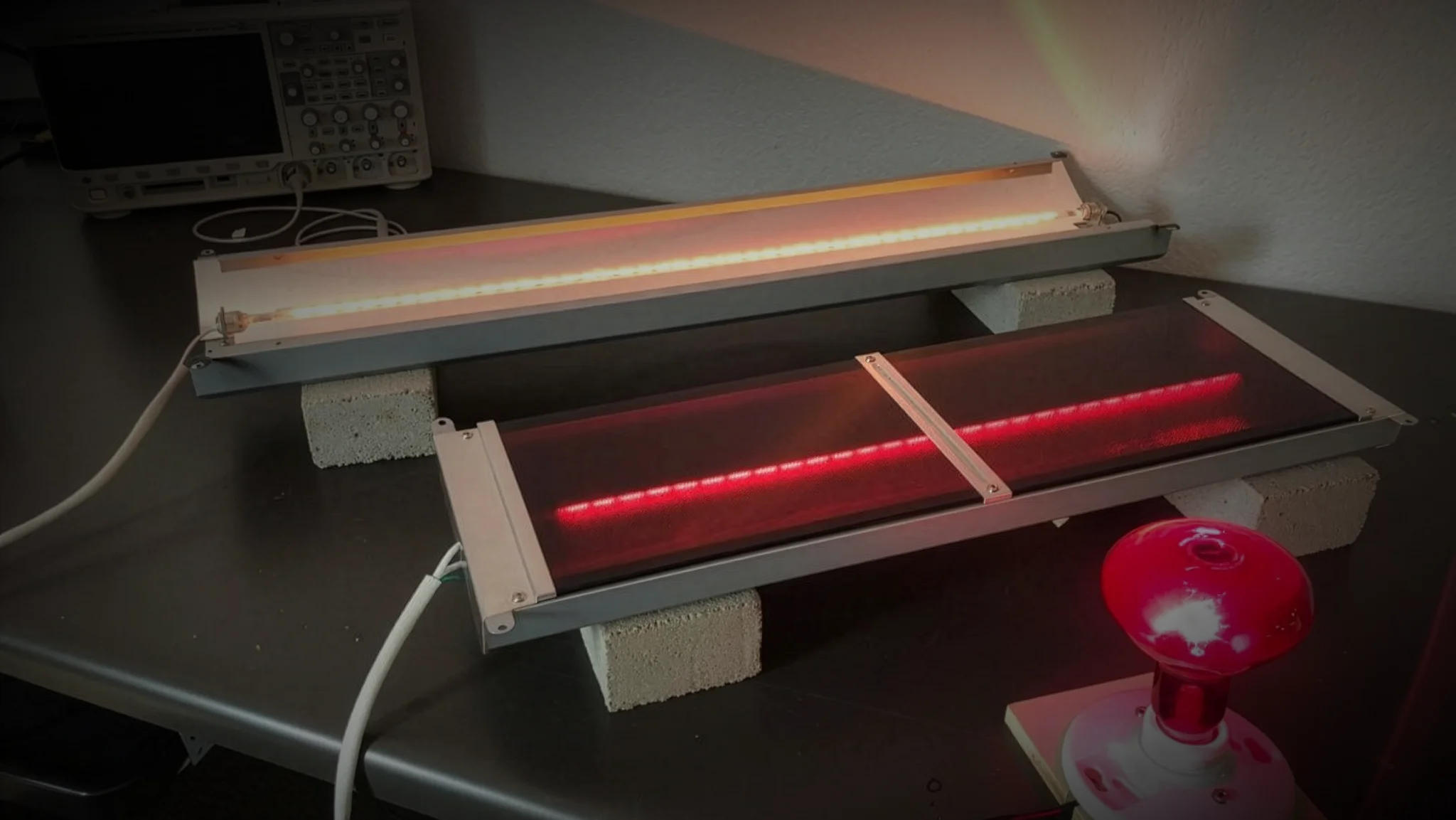
Far Infrared or Full Spectrum? What the Near Infrared Research Says
We build both, at the same price, and we recommend far infrared. Here's the research behind that recommendation, so you can weigh it yourself.
On this page10 sections

Our recommendation is far infrared
For a sauna you’ll use for years, we recommend far infrared. High, long-term exposure to near and mid infrared is linked to cataracts, and lab studies link near infrared to skin aging and impaired cell repair. There are exposure limits for the eyes, but none for those skin effects, and no one has established a safe level of near infrared for daily, whole-body use.
Reasonable people read this research differently, so we also build a full spectrum option to the same standard. Only the front heaters change, and the choice is yours.
When our full spectrum heaters arrive (available for pre-order now) in January ’27 , we will sell far infrared and full spectrum front heaters for the same price. Full spectrum costs the same as far infrared, so there’s nothing to upsell. Our recommendation is just that: a recommendation.
Every infrared sauna is mostly a far infrared sauna
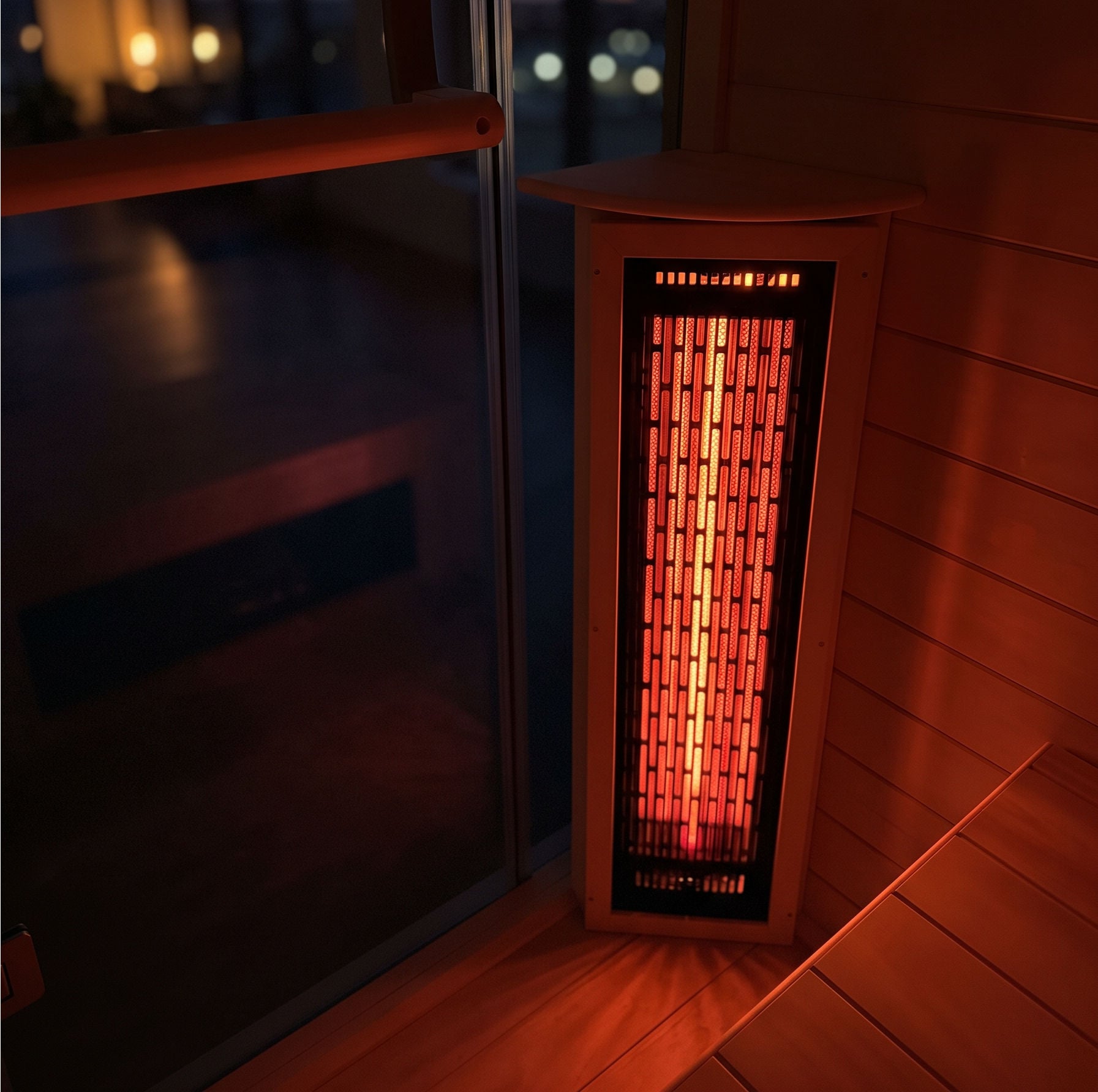
In most saunas sold as full spectrum, the near and mid infrared comes from the heaters in front of you. The heaters behind you and under the bench are far infrared.
Ours are built the same way. Choose full spectrum and your front heaters change, while your back and under-bench heaters stay far infrared. In a two-person sauna, three of your five heaters are far infrared either way.
So the choice isn’t between two kinds of sauna. It’s whether you want near infrared from the heaters in front of you.
Near, mid and far infrared: what's the difference?
- Near Infrared (NIR): (780 nm – 1400 nm) The shortest and most penetrating wavelengths. About half of the near infrared that reaches the body is absorbed in the dermis, the skin’s deeper layer (Schroeder, 2006).
- Mid Infrared (MIR): (1400 nm – 3000 nm) Absorbed closer to the surface than near infrared.
- Far Infrared (FIR): (3000 nm – 1 mm) Absorbed at the surface of the body, where you feel it as radiant heat. Every Transcend® heater produces far infrared.
Full spectrum front heaters produce all three bands.

What does near infrared do to the body?
Near infrared is used successfully in targeted therapies, with measured doses to small areas. A sauna is different: it exposes your whole body, eyes included, for 30 minutes or more, several times a week. These are the findings that shape our recommendation.

Can near infrared damage your eyes?
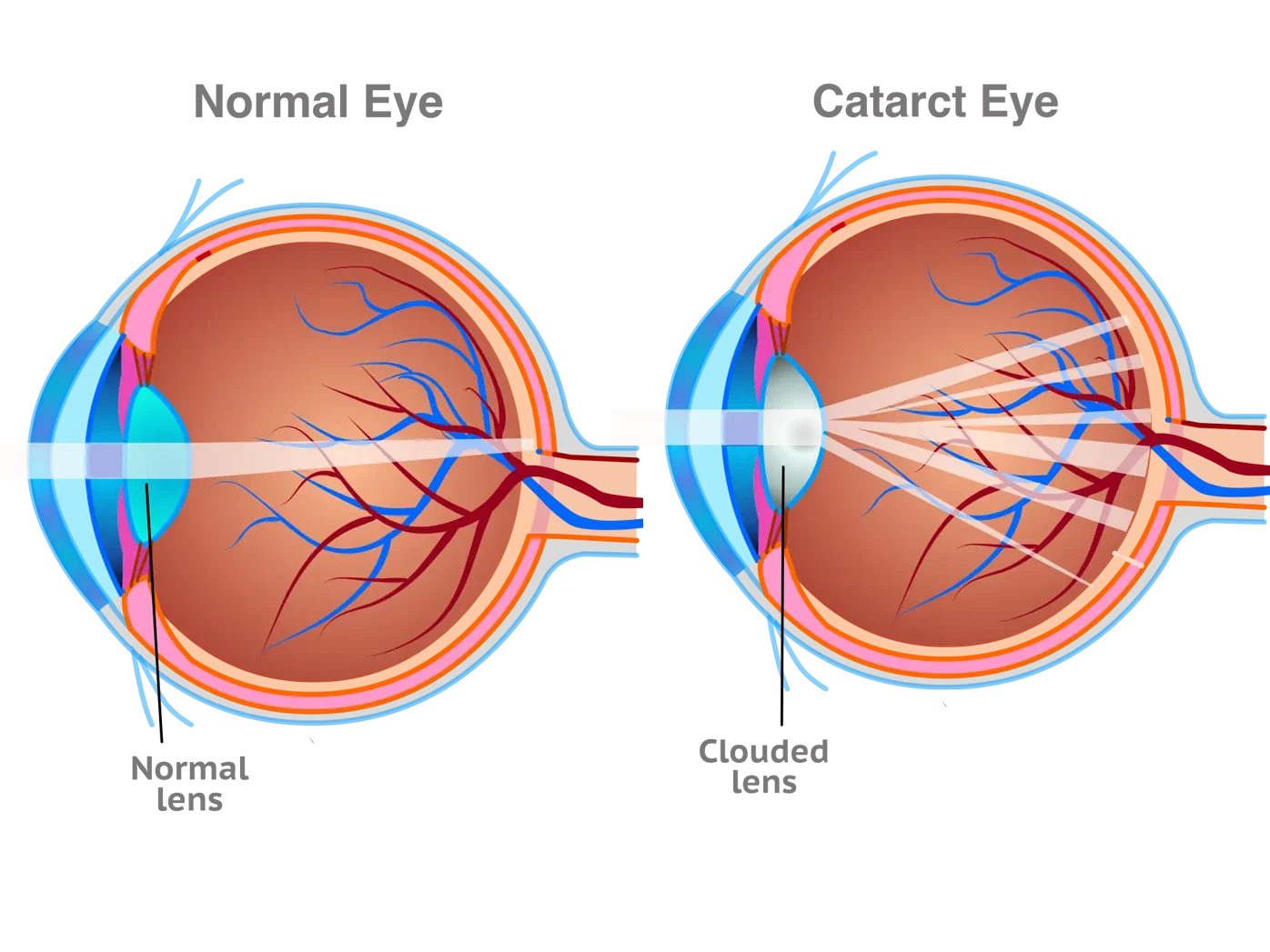
At high, long-term exposure, yes. Near and mid infrared (roughly 800–3,000 nm) can heat the lens of the eye, and years of intense exposure cause cataracts in glass, iron and steel workers.
- In a large Swedish study, 32% of iron and steel workers aged 60 and older had wedge-shaped lens opacities, a common form of age-related cataract, compared with 12% of controls. Younger workers showed no difference. Among glass workers over 70, 16% had had cataract surgery, compared with 1% of controls (Lydahl, 1984).
- Animal studies at high intensities show how: infrared reduced the soluble proteins that keep the lens clear (Aly, 2011) and raised enzymes that break down structural proteins in the cornea and lens (Dadoukis, 2013).
- The International Commission on Non-Ionizing Radiation Protection (ICNIRP) limits long-term eye exposure to near and mid infrared to 100 W/m². The workers who developed cataracts were exposed daily to roughly 800–4,000 W/m² for 10–15 years. ICNIRP notes that long-term data are sparse, but current knowledge suggests no effects below its limits (ICNIRP, 2013).
Far infrared is absorbed at the surface of the eye, and ICNIRP doesn’t consider far infrared from heaters and lamps an eye hazard beyond heat stress (ICNIRP, 2013). In a full spectrum sauna the near infrared heaters face you, so we recommend eye protection (see If you choose full spectrum, below).
Does near infrared age the skin?
In lab studies, repeated near infrared exposure causes the same kind of damage as UV light: more collagen breakdown and, in animals, deeper wrinkles.
Near infrared is absorbed by the mitochondria in skin cells, where it generates reactive oxygen species, also called free radicals (Schroeder, 2007; Darvin, 2010). These raise levels of MMP-1 (Schieke, 2002; Buechner, 2008; Cho, 2008; Schroeder, 2008a; Calles, 2010; Costa, 2015), an enzyme that breaks down collagen and elastin (Krutmann, 2011).
The visible result is photoaging: coarse wrinkles, uneven pigment and lost elasticity (Yaar, 2006; Schroeder, 2008b). In hairless mice, infrared alone caused wrinkles and worsened those caused by UV light (Kim, 2005). In guinea pigs, it intensified UV damage in the dermis (Kligman, 1982).
The research points the other way for far infrared. In mouse skin cells and hairless mice, far infrared reduced the collagen breakdown and skin thickening caused by UVB (Chiu, 2017).


Can near infrared cause cancer?
There’s no evidence that near infrared saunas cause cancer. The concern is narrower: in lab studies, near infrared helped skin cells with UV damage survive when they would normally self-destruct.
When UV light damages a skin cell’s DNA, the cell normally triggers its own death, called apoptosis, so it can’t become cancerous. In lab studies, near infrared reduced that response after UV exposure. One study traced this partly to near infrared also reducing the DNA damage, which is reassuring (Jantschitsch, 2009). It also changed the activity of 599 genes in skin cells, 11 of them tied to apoptosis (Calles, 2010). Another found less GADD45a, a protein involved in DNA repair: 57% less at 48 hours and 35% less at 72 hours (Costa, 2015).
The most direct study looked at melanocytes, the pigment cells where melanoma starts. Near infrared alone didn’t change their survival. Combined with UVB, it let more DNA-damaged cells survive, without improving their repair. The authors suggest this could let UV damage build up over time (Kimeswenger, 2016). That’s the finding that gives us pause.
These are lab findings, often at intensities that differ from a home sauna, not outcomes measured in people. They’re one reason we want more research before recommending near infrared for daily, whole-body use.
Why positive near infrared studies don't apply to saunas
We read every study customers send us. Most positive near infrared results come from a different dose, a different device or a shorter timeline than a sauna.
Dose and control
Photobiomodulation studies deliver a measured dose of light to a small area for minutes, from lasers or LEDs at a fixed distance. A sauna heater fills a room and reaches you at whatever distance you sit, for 30 minutes or more, several times a week. A result from the first doesn’t tell us what happens in the second (Barolet, 2016).
Darvin (2010) reached a similar conclusion: near infrared may help with occasional skin problems, but habitual exposure should be avoided because of the free radicals it generates. If you have an open wound, see a doctor rather than a sauna.
Timing
Some effects take days to appear. In one study, antioxidant enzymes dropped at 24 and 48 hours, but the rise in MMP-1 didn’t show up until 72 hours (Costa, 2015). A two-day study would have missed it.
In another, a single dose looked beneficial: MMP-1 fell and procollagen, a marker of new collagen, rose. With repeated exposure, three times a week for four weeks, the result reversed (Kim, 2006). For a sauna you’ll use for years, we weigh repeated-exposure studies most heavily.
Is there a safe dose?
Possibly. Barolet (2016) proposed that near infrared may have a beneficial low-dose range, a pattern called hormesis. If that range exists, no one has defined it for whole-body exposure, or whether it depends on the light’s bandwidth or coherence. In a sauna, your dose changes every time you lean forward or sit back. If research establishes a reliable whole-body dose, we’ll revisit our recommendation.

Built to the same standard, at the same price
If you’ve weighed the research and want near infrared, our full spectrum option gives you that in a sauna built like every other High Tech Health sauna.
- Same price as far infrared (coming in January 2027; or get far infrared now and 1/2 off a pre-ordered full spectrum set).
- Front heaters only. Your back and under-bench heaters stay far infrared.
- Built by us. Our full spectrum heaters have essentially no electric field, a magnetic field that’s low at knee height and negligible at torso height, and no hot spot you can touch.
- Published measurements. Their magnetic field isn’t as low as our Transcend® heaters’, and we publish the measurements for both. Optional Full Spectrum Heaters →
- The same cabin. Triple Antifield™ mitigation of electric, magnetic and RF fields, from the heaters through the wiring and controls; 46% less CO₂ in the cabin; 100% solid wood.
- Eye protection recommended.
Which should you choose?
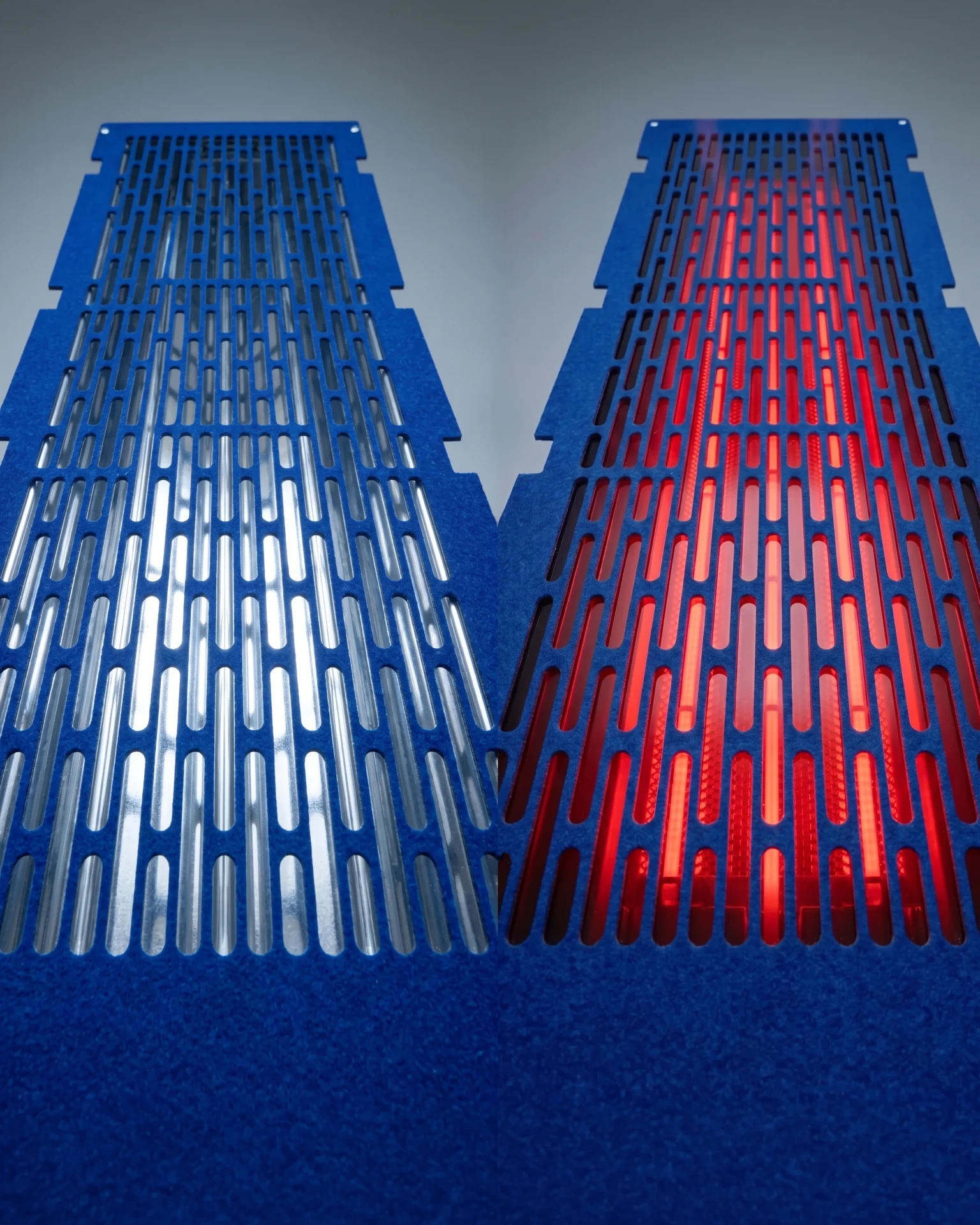
Choose far infrared if you want our recommendation, plan to use your sauna most days for years, or would rather not think about eye protection.
Choose full spectrum if you’ve read the research and want near infrared in your sessions. You’ll get a sauna built to the same standard, at the same price.
We keep reading the research. If it changes, our recommendation will too.
In 90 seconds we’ll tell you which Transcend fits you and why. Take the Quiz →

Keep reading
- Transcend® Heaters (far infrared)
- Optional full spectrum heaters
- Dangers of EMF